

The best digital marketing agency for a roofing or paving company trying to rank on Google Maps is the one that can show dated, city-level local pack evidence and tie it to calls and direction requests. Rankings alone do not pay for a crew. Sunstone Digital Tech has built its Local SEO practice around that standard. It has served 2,500+ clients since 2018, holds a 4.9/5 Google rating, and reports 73% lead growth in 60 days across its local lead generation work.
This case study walks through the Map-first process we use for roofers and pavers: the baseline problem, the tactics and the reasoning behind their order, how results are measured, and what owners can apply immediately. It also lays out the proof you should demand from any agency you evaluate in 2026.
How to judge an agency for roofing and paving Google Maps SEO
Many agencies publish roofing SEO case studies. Fewer publish proof that survives scrutiny. The most common weaknesses in published examples are undated screenshots, percentages with no baseline, and “more organic calls” with no call counts. A case study that cannot be checked is a sales page.
Use this checklist when comparing agencies:
| Evidence to request | What good looks like |
|---|---|
| Local pack screenshots | Dated before and after, shown per city or service area, not one blended number |
| Keyword coverage | Top 3 coverage for specific service terms such as “roof repair” or “asphalt driveway repair” |
| GBP engagement | Calls and direction requests from the Google Business Profile, with a start and end date |
| Lead attribution | Call tracking and conversion tracking that separate Maps from other sources |
| Timeline | Week 2, Week 4, and Month 3 snapshots, so progress is visible rather than asserted |
| Tactic transparency | A clear list of what was changed in the profile, citations, reviews, and site |
An agency that answers all six is worth a conversation. One that offers only a proprietary “system” name and a headline percentage is not.
Client background and objectives
The scenario below is a composite of the situation roofing and paving owners bring to Sunstone Digital Tech. It is not a single client’s record, so it contains no invented rankings or revenue figures. The verified figures later in the article come from Sunstone’s published results.
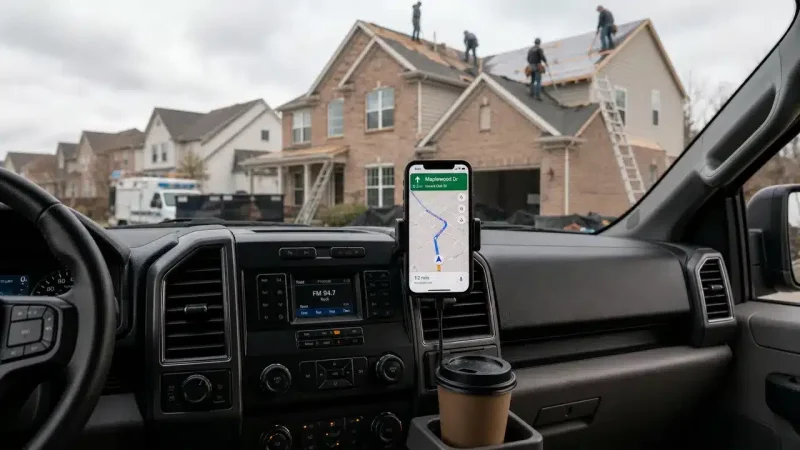
Picture a residential roofing and paving contractor serving a core city and four neighboring towns. Typical jobs are roof repair, full replacement, driveway repair, and new asphalt installs. Customers are homeowners who search from a phone, often right after a storm, a leak, or a cracked driveway turns into a problem. They tap one of the first three businesses in the Google Maps pack and call.
The owner’s goal in Map terms is simple: appear in the top three for the services that produce the most profitable jobs, in each town the crew actually serves. The success metrics are:
- Calls from the Google Business Profile
- Direction requests and website clicks
- Form leads from local landing pages
- Top 3 local pack coverage for core service keywords
- Booked estimates traced back to Maps
Owners in this position usually describe the same frustration. They know the work is good and the reviews are decent, yet a competitor two miles away keeps showing up first. That is a visibility problem, and it can be diagnosed.
Baseline: where a roofer or paver loses the local pack
Before any change, the baseline audit documents the position as it stands. It has four parts.
Local pack position by area. A grid-style rank check records where the business appears for each service keyword in each town, with the date stamped. A roofer often ranks well within a few blocks of the office and disappears three miles out. That drop-off explains why leads feel inconsistent from week to week.
GBP engagement. Google Business Profile Performance data shows monthly calls, direction requests, and website clicks. These become the “before” numbers.
Lead flow by source. Call tracking and form data show how many inquiries come from Maps versus paid search, referrals, and direct traffic. Without this split, no one can say what Maps work produced.
Friction points. The audit usually finds some combination of these:
- A primary category that does not match the most profitable service
- Low review velocity, or a last review that is months old
- Inconsistent name, address, and phone details across directories
- Duplicate or outdated listings
- One generic “Services” page instead of pages that match intent, such as roof repair versus roof replacement
Each friction point maps to a known local pack ranking factor: relevance, distance, and prominence. Distance cannot be changed. Relevance and prominence can.
Tactics executed: GBP, citations, reviews, and local pages
Google Business Profile optimization for roofers and paving contractors
The profile is the asset that appears in the pack, so it is fixed first.
- Categories and services: The primary category is aligned to the highest-value service (for example, roofing contractor for a roofer, paving contractor for an asphalt company), with secondary categories added only where the business genuinely offers the service. Services are listed with descriptions that use the same terms customers search.
- Attributes and details: Hours, service areas, and attributes are completed and verified.
- Photos and video: A steady plan of real job photos, before-and-after shots, and crew images replaces stock imagery. Fresh, geo-relevant media signals an active business.
- Posts: Seasonal posts match demand, such as storm damage and gutter-adjacent roof checks in spring, and sealcoating or crack repair before winter.
- Cadence: Posting and updates run on a set schedule rather than in bursts.
Service area strategy for multi-city coverage
Google does not reward listing twenty towns in a profile. Coverage is built by pairing a verified primary location with service-area settings and supporting pages for each town that has real demand. Where a business has no physical office in a town, the plan is realistic about what Maps can deliver there and leans on organic results and localized pages instead. Claiming every neighbor will rank equally would be inaccurate.
Local citations for roofing and paving companies
Citation work is about accuracy, not volume. The workflow is:
- Lock a single canonical name, address, and phone format.
- Audit the major data aggregators, core directories, and trade-specific sites.
- Correct inconsistencies and suppress or merge duplicates.
- Add listings in priority directories where competitors appear.
Inconsistent data weakens trust signals. Cleaning it up is unglamorous and rarely reverses rankings alone, but it removes a drag on everything else.
Roofing reviews growth strategy for Google Maps
Reviews affect both ranking prominence and whether a searcher calls. A 4.1-star profile loses calls to a 4.8-star neighbor even at an equal rank. The review program covers:
- A request sent within a day of job completion, by text or email, with a direct review link
- Short messaging guidance so crews ask in a natural way
- A response workflow for every review, positive or negative, within a set window
- A recency target so the profile never looks dormant
Review growth takes time. Incentivizing reviews violates Google’s policies, so the program relies on consistent asking instead.
Service area pages for roofers and pavers
Each priority service in each priority town gets a page that matches search intent. A homeowner searching “roof repair” wants a fast fix and a price range. A homeowner searching “roof replacement” wants materials, warranties, and financing. Paving works the same way: driveway repair and new driveway installation are different decisions. Pages include local project examples, service details, and clear calls to action. Keyword-to-page mapping prevents two pages from competing for the same query. Sunstone’s SEO for roofing businesses work follows this structure.
Measurement setup
Attribution is built before results are claimed. That means call tracking on the profile and site, conversion tracking for forms, and a reporting cadence that reviews GBP calls, direction requests, and lead counts together. If the owner cannot see which calls came from Maps, the program cannot prove its value.
Why this order: profile, data, reviews, then pages
The sequence follows how Maps decides who shows up. Profile accuracy and category alignment come first because they affect relevance directly and cost little to correct. Citation cleanup comes next because inconsistent data undermines trust in everything else. Review velocity runs in parallel because it takes the longest to compound. Localized pages follow, since they support both Maps and organic results and take more build time.
Starting with a new website, or with paid ads alone, would skip the cheapest and fastest gains. Sunstone’s full-service model covers Local SEO, paid media, conversion-focused web design, content, and automation, so the order can adjust to a market. A highly competitive metro may call for paid search to hold lead volume while Map rankings build.
Results: what is measured, and what Sunstone reports
Results for a Map-first program are reported in layers, with dates on every artifact.
- Week 2: Profile changes are live, tracking is verified, and the baseline grid is documented.
- Week 4: Early movement in local pack positions near the business address, plus the first change in GBP calls and direction requests.
- Month 3: Top 3 coverage compared across each target town, calls and form leads compared with baseline, and review count and recency compared with the starting point.
Timing varies by market competition and starting condition. Early ranking signals commonly appear within the first weeks. Conversion impact becomes clear once rankings hold and review counts rise.
Sunstone’s published figures give the broader context for these programs:
- 73% lead growth in 60 days, as reported on its local lead generation work
- 3.8x return on ad spend for qualified campaigns
- 4.9/5 Google rating across 2,500+ clients
- 6,000+ projects completed and $112,180,461+ in revenue generated for clients
Sunstone’s case studies also report outcomes such as 187% traffic growth, 312% ranking growth, and 164% more organic leads. Those are program-level results, and individual outcomes depend on market, competition, and starting position. Any roofer or paver should ask for the screenshots, dates, and call counts behind a specific engagement before signing.
Lessons roofers and pavers can apply this month
- Check the primary category first. If it does not match the service that earns the most margin, change it before anything else.
- Standardize your name, address, and phone number. Pick one format and make every listing match it.
- Set a review rhythm. A request after every completed job beats a monthly push. Reply to every review.
- Build separate pages for separate intents. Roof repair and roof replacement, or driveway repair and new paving, should not share a page.
- Turn on call tracking. GBP calls and direction requests are the numbers that connect Maps to revenue.
The causal chain is consistent: better Map visibility increases profile engagement, engagement produces calls and direction requests, and calls become booked estimates. Skip a link and the result stalls. A high rank with a weak review profile leaks calls, and strong reviews with no tracking leave the owner guessing.
Next steps for similar roofing and paving clients
For a client like the one described, the next phase after the first three months typically includes expanding to additional towns with dedicated pages, running conversion rate optimization tests on the highest-traffic service pages, and continuing the posting and review cadence. Commercial roofers targeting property managers follow a related path, outlined in Sunstone’s work as a commercial roofing marketing agency. Answer-engine visibility (AEO and GEO) is added as buyers increasingly use AI-driven search to find contractors.
If you want a Map-specific audit of your own market, Sunstone Digital Tech offers a free proposal covering your current local pack position, GBP gaps, citation accuracy, and review profile. You can see how the work is structured on the local SEO services page or the roofing marketing agency page, then request a proposal to see where your business stands against the contractors showing up ahead of you.